

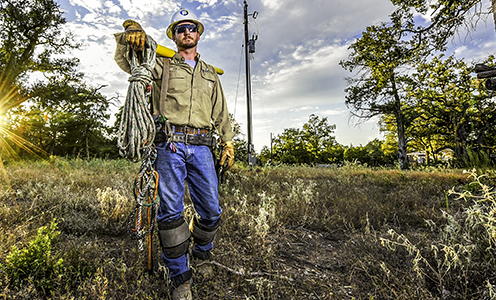


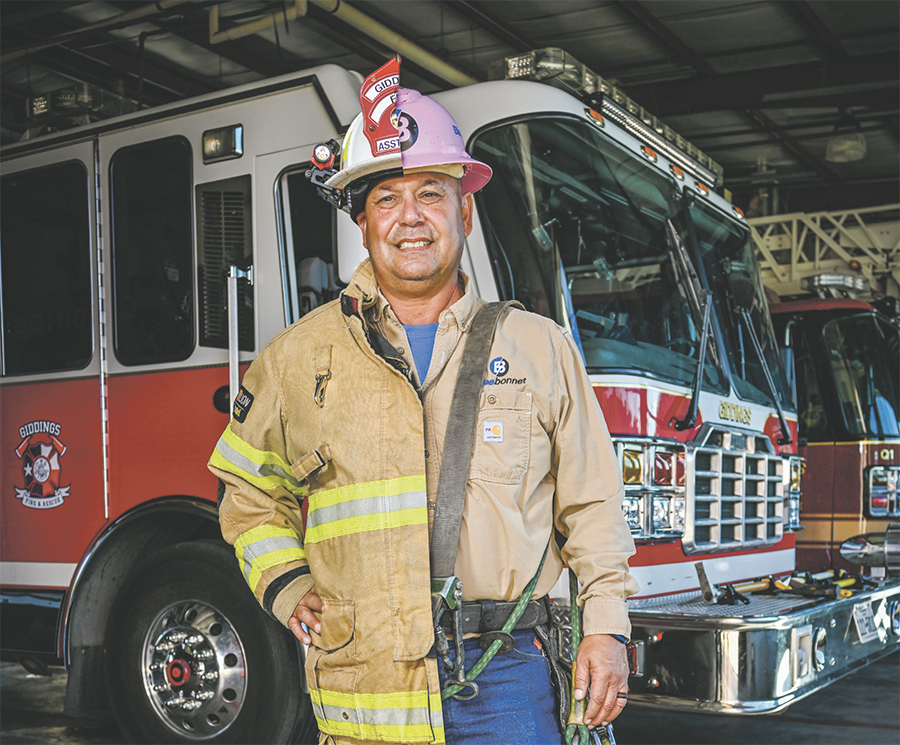
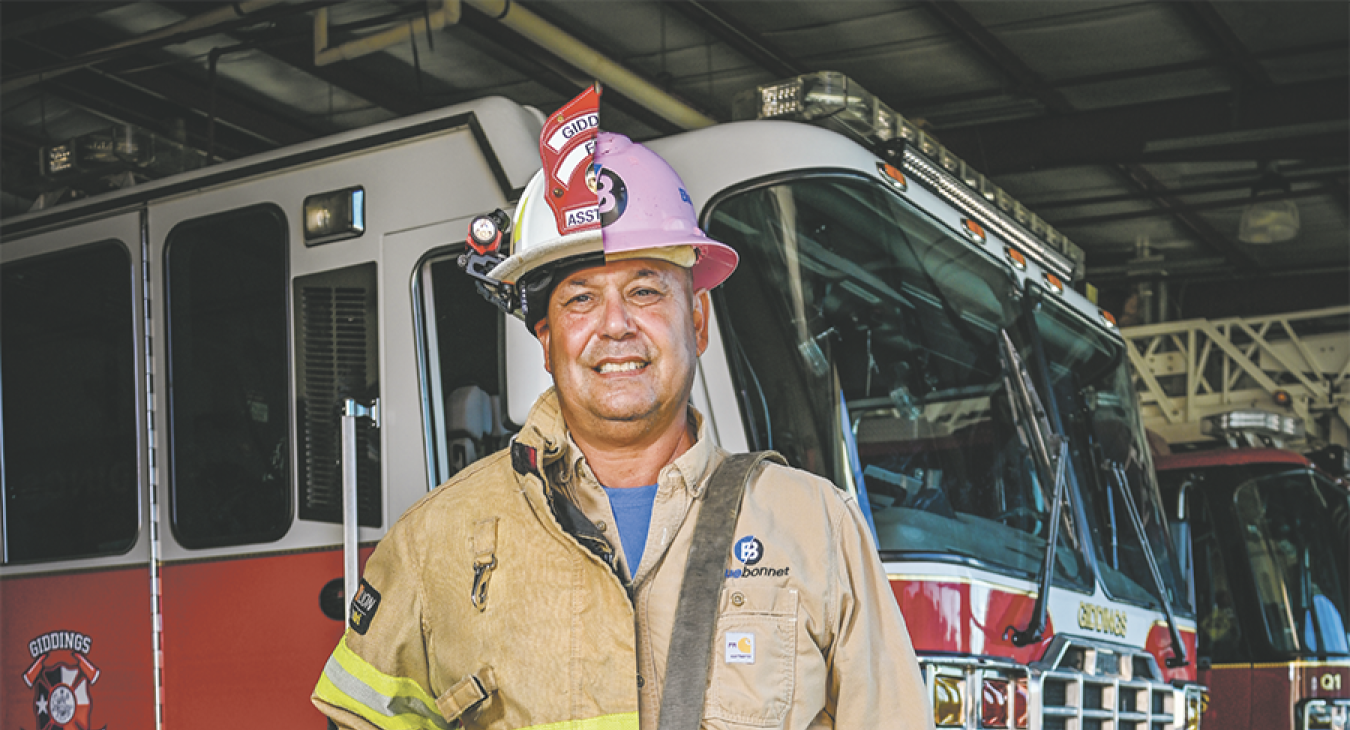
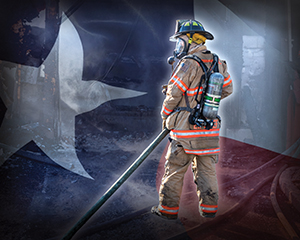
Journeyman lineworker Rudy Garcia wears two uniforms — and many hats — as a Bluebonnet employee and assistant fire chief for the Giddings Fire Department. This photo illustration shows Garcia dressed for his dual callings while standing at the fire department's station on Independence street. He has served with Bluebonnet and the Giddings Fire Department for more than three decades. Sarah Beal photo illustration
Fifteen Bluebonnet employees are committed to community service through their work with volunteer fire departments and first responder units
Story by Connie Juarez • Photos by Sarah Beal
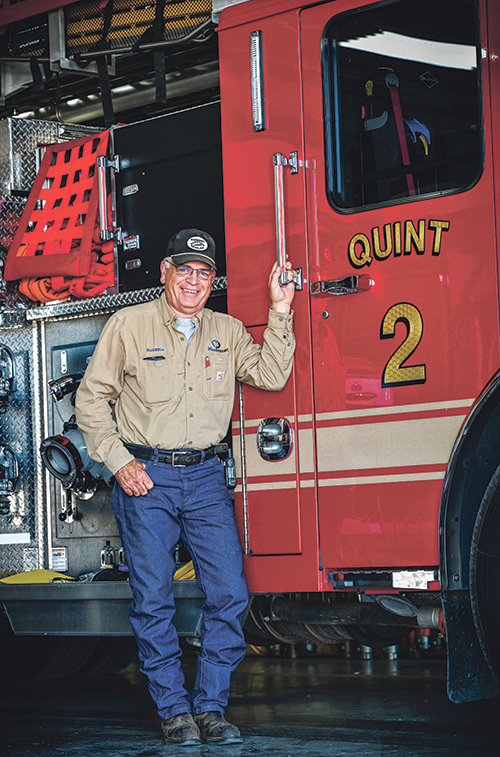
Russell Tiner and his wife were dressed and ready to leave their home in Lockhart to head out for their 20th wedding anniversary dinner. Then his pager went off.
The call wasn’t about his job as a lineworker at Bluebonnet Electric Cooperative.
VIEW THIS STORY AS IT APPEARS IN THE JANUARY 2026 ISSUE OF TEXAS CO-OP POWER MAGAZINE
This was about a fire in the grain and corn bins at Livengood Feeds in Lockhart. Instead of celebrating over a meal,
Tiner spent hours unloading corn and knocking back hot spots alongside the Lockhart Fire Rescue crew.
“My wife understood,” he said with a laugh about that event 16 years ago. “We never made it to dinner that night.”
Tiner has worked for Bluebonnet for 27 years. As a journeyman lineworker, he builds and maintains power lines and restores electric service.
He has also volunteered as a firefighter for the last 36 years, 25 of them as a certified emergency medical technician with Lockhart Fire Rescue and Mid-County Fire/Rescue. The departments cover 72 square miles between Luling and Lockhart in Caldwell County. Lockhart Fire Rescue, in operation for more than 135 years, has 17 firefighters, and Mid-County, founded in 1983, has 16.
Tiner contributes about 20 hours of volunteer service each month, assisting with some of the approximately 40 calls the two departments receive monthly. He has battled grass fires, applied tourniquets and treated severe wounds.
His expertise with Bluebonnet’s electric infrastructure has been an asset during emergency responses. If power lines are down around a structure fire or car wreck, he can quickly assess the scene and disconnect power before other first responders arrive. “I hear the call, and I’ll pull up right behind them,” Tiner said. “I can make the scene safe and get people where they need to be. Responders in Caldwell County have come to know me for that.”
The Bluebonnet region is served by more than 100 first-responder divisions, agencies, districts and teams, with origins dating back as far as 1848. Fifteen Bluebonnet employees, including Tiner, volunteer with a dozen fire departments and emergency units spread across the cooperative’s 3,800-square-mile service area.
By day — and sometimes night — they restore electricity and ensure homes, farms and businesses have power. When duty calls, they put on another uniform and come to the aid of their communities. Their work stretches from Lockhart to Giddings, from Milano in Milam County to Carmine in Fayette County.
For residents in Bluebonnet’s rural service area — where larger fire departments or ambulance services may be miles away — help often comes from hundreds of local volunteer first responders ready to save lives and protect property.
“Volunteers are the lifeblood and the first line of defense for emergency management response, whether that's a fire or a medical emergency,” said James Altgelt, coordinator of Bastrop County’s Office of Emergency Management. “Volunteer fire departments arrive quickly, bring every resource they have and often stop a situation from becoming catastrophic.”
Restoring electricity and responding to emergencies require similar mindsets, skills and commitments to the job. Both require keen situational awareness, strict safety protocols, teamwork under pressure and technical skills. Whether climbing poles in a storm or stabilizing a patient at a crash scene, these employees bring the same precision and dedication to every call.
“We’re incredibly proud of the number of employees who show up when their communities need them most, serving as volunteer first responders outside of work,” said Eric Kocian, Bluebonnet’s chief engineer/systems operations officer.
“Safety is a top priority for Bluebonnet. That commitment carries over beyond the workplace — these individuals take the same care and focus when volunteering, ensuring neighbors stay safe. That deep sense of duty and service is who we are. Safety, commitment and community are at the heart of everything we do.”
Another journeyman lineworker, Rudy Garcia, has been at Bluebonnet for 30 years and a volunteer firefighter for 31. Garcia, who lives in Giddings, serves as assistant chief of the Giddings Fire Department’s 34 active members. Most are volunteers; two are paid firefighters. In 2025, the department responded to about 370 calls, mostly vehicle accidents and grass or structure fires.
Linework and firefighting require planning and the ability to assess many aspects of a situation. “You can’t get tunnel vision. Just like at Bluebonnet, you get a call, and you don’t know what it is,” Garcia said. “Same with fire. You have to clear your head, figure out whether people are still inside, how you’re going to approach it and who’s going to be on the nozzle.”
Garcia remembers one particularly difficult call in 2015. It was around 7 on a chilly April morning, just after a downpour.
His fire department responded to a vehicle crash and water rescue at Yegua Creek in Lincoln. A driver had been trapped inside his semi-truck cab after it rolled off Texas Highway 21 into the rushing creek. Fifteen firefighters from the Giddings department and about 10 from Lincoln VFD worked together on the rescue. “We tied 100-foot-long ropes around ourselves so we wouldn’t get swept away,” Garcia recalled. “We cut the roof off the truck, used the Jaws of Life to pry open the door and pulled him to safety. He was not injured at all.”
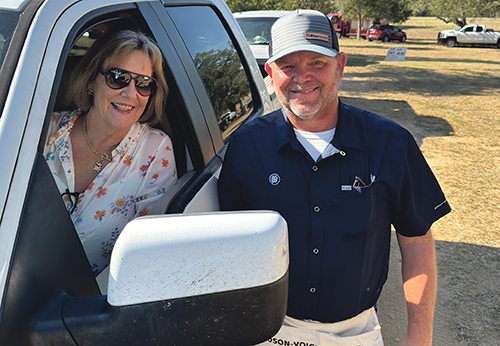
Others bring teamwork skills they hone at Bluebonnet to their volunteer firefighting work. Scott Iselt, who lives in Fedor, is a project manager in Bluebonnet’s engineering department and has been with the cooperative 20 years. He has served with the Fedor Volunteer Fire Department for three decades. The department covers a 46-square-mile rural area in north-central Lee County south of Lexington.
“Most of the calls we respond to are grass fires, some motor vehicle accidents and a lot of traffic control,” Iselt said. With 15 volunteer firefighters, knowing a team’s limitations is key. “Often, our response team is just two men — one driver, one working the hose.”
That makes mutual aid and radio coordination important. Iselt’s previous background training with the Texas Department of Public Safety enhances his ability to interact with the public during incidents. “This translates to effective traffic management and clear, authoritative communication with people at emergency scenes,” he said. Whether working to restore power for Bluebonnet or responding to a fire, Iselt said, safety requires keeping everyone on the same page and maintaining good teamwork.
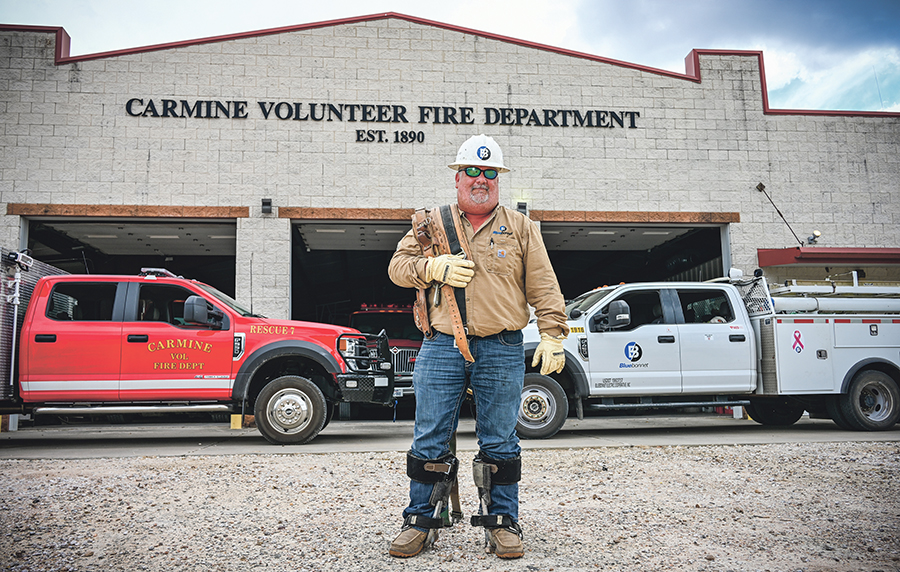
Jason Carmean has been a Bluebonnet employee for 32 years. He is a lineworker crew supervisor and lives in Carmine, where he has been a part of the Carmine Volunteer Fire Department for 22 years. The department, established in 1890, has 16 active volunteers. The small community straddles U.S. 290 in Fayette County north of Round Top. Carmean was fire chief there for six years, and has seen nearly every type of emergency, from farm accidents to oil well incidents.
He recalled stabilizing an injured passenger who was trapped inside a vehicle after a crash. “I crawled into the back seat, held his neck, gave oxygen and kept him stable until STAR Flight arrived.” Doctors later told Carmean that without his patience and support, the patient could have been paralyzed.
For Carmean, safety is a priority in both linework and first-responder work. “At Bluebonnet, I supervise crews and make sure they’re safe. It’s the same on fire calls. Leadership and awareness carry over both ways.”
That sense of responsibility isn’t
limited to the job site — it extends to every fire call. For Garcia, the connection between leading crews and answering emergency calls runs deep, rooted in a lifelong passion for helping others.
Garcia’s interest in emergency response started as a child growing up in South Texas, where he watched the fire station near his school. “When the sirens would go off, I’d go to the window and look. I was like, ‘You know, I want to be a fireman.’ ”
Years later, a friend encouraged him to join the Giddings Fire Department.
Tiner’s path to emergency services began when he was 5, and a neighbor’s house in Austin caught on fire. A child was trapped inside, and Tiner watched fire trucks race to the scene. “I watched a fireman go in and come back out with that baby in his hands. Everything turned out all right, but I never forgot that,” he said.
The Bluebonnet employees shared their desire to help neighbors and give back to the places they call home. They have a chance to make a real difference, protect property and save lives.
Balancing full-time work at Bluebonnet with volunteer work requires personal and family sacrifices. Long nights, interrupted holidays and early mornings are common. Tiner recalls one Christmas morning when a call came in: “We were gathered around the tree, opening presents, and I got a call for a fire on San Antonio Street in Lockhart. My wife looked at me and said, ‘Let’s go.’ My family loaded up in the family truck with me. The kids brought their stockings and opened them on the way.”
For Iselt, volunteering in his community of Fedor, 17 miles northwest of Giddings in Lee County, has even meant responding to a family member’s emergency. One night in 2017, he recalled, his crew was called to provide a landing spot for a medevac helicopter. When Iselt got the address, he realized it was the home of his uncle, whom he learned was unresponsive after a fall. “We raced over there, prepared the landing zone — finding a spot free of power lines, trees and cars — then fenced off the perimeter with our trucks,” he said. “It was pitch dark, but I helped get him safely onto the helicopter.”
Before he heads out on a call, Garcia has a little ritual. “I always give my wife, Amber, a kiss. It's not just a sentimental gesture. In this line of volunteer work there is always some risk involved.”

A first responder may face a set of challenges that can hit harder than those of a lineworker — situations that are often unsettling. Carmean has learned how to manage the pressure of emergency response while staying focused and grounded. “I tell my teams that you can respond to calls and come back without carrying the weight of it with you,” he said.
For particularly traumatic emergency response situations, support is available to first responders, he said. Carmean has learned ways to cope. “When I leave, I leave it behind,” he said. His emergency response training has given him tools to stay calm, even on the toughest calls.
Community support keeps fire departments equipped, but the bonds among responders keep them going.
“It takes a certain kind of person to do this work,” Carmean said. “You have to be willing to get up in the middle of the night or suit up in 104-degree weather after a full day’s work — for no pay. But the camaraderie makes it worth it. The fire department is like a brotherhood, just like the linemen at Bluebonnet.”
There’s a larger calling at the heart of volunteer work that has carried these volunteers through decades of responding to calls that could be dangerous. “I actually have a passion for this,” Garcia said. “To me, it’s always felt like a God-given talent. This is why I’m still able to do it after all these years.”
DOUBLE DUTIES
15 Bluebonnet employees volunteer with fire departments and first-responder units

SHAWN BIGON
Apprentice lineworker
Years at Bluebonnet: 3
Volunteer: Assistant chief, South Lee County Volunteer Fire Department
Years of service: 14
“I joined the fire department to help protect my community. My favorite memory is entering my first structure fire and putting all the training I went through to use.”

MICHAEL BLAND
Engineering inspector
Years at Bluebonnet: 2
Volunteer: Battalion chief, Bastrop County Emergency Services District No. 2
Years of service: 15
"It has been a great experience getting to know many people in the community, being part of the best volunteer department in Texas and serving with the greatest volunteers in the country.”
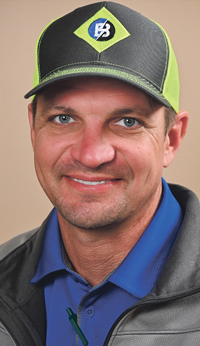
KYLE KASPER
Lineworker crew supervisor
Years at Bluebonnet: 20
Volunteer: Firefighter, South Lee County Volunteer Fire Department
Years of service: 18
“Between being on call for Bluebonnet and all the other things going on, it can be hard to find time for everything — but we do our best to make it work.”

ERIN KIESCHNICK
New service operations supervisor
Years at Bluebonnet: 15
Volunteer: Board member, former secretary, Lincoln Volunteer Fire Department
Years of service: 10
“At work, we often talk about wearing many hats — and volunteering is no different. Whether it’s directing traffic, organizing volunteers or showing up on scene with water and food, you step up where you’re needed.”
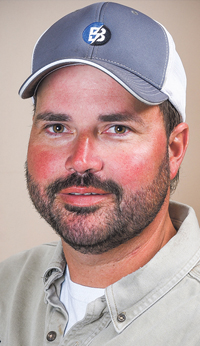
KYLE KIESCHNICK
Substation construction project manager
Years at Bluebonnet: 7
Volunteer: Captain, Lincoln Volunteer Fire Department
Years of service: 18
“Managing time is a constant juggling act. Lots of late nights, early mornings and staying focused during the day.”

LOGAN LANCASTER
Lineworker crew supervisor
Years at Bluebonnet: 12
Volunteer: Fedor Volunteer Fire Department
Years of service: 8
"Someone asked me if I would be willing to help out, and I was willing to do what was needed to raise funds to support the department.”

JUSTIN LEWIS
Apprentice lineworker
Years at Bluebonnet: 3
Volunteer: Firefighter, Ellinger Volunteer Fire Department
Years of service: 1.5
"Bluebonnet is a very community-friendly organization. I get a good feeling of helping others when I restore power, and I get that same feeling when helping individuals in the community while volunteering.”

BRIAN MITSCHKE
Technical services superintendent
Years at Bluebonnet: 21
Volunteer: Firefighter, Dime Box Volunteer Fire Department
Years of service: 10
“I assisted first responders when a wreck occurred right in front of me one day many years ago and have volunteered with Dime Box VFD ever since.”

PHILIP THARP
Journeyman lineworker
Years at Bluebonnet: 11
Volunteer: Firefighter and cook, South Lee County Volunteer Fire Department
Years of service: 15
“There really is no time management as a first responder. If you can go to a call, you go.”
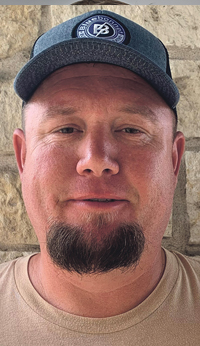
BRYAN WOODS
Lineworker crew supervisor
Years at Bluebonnet: 3
Volunteer: Firefighter, Milano Volunteer Fire Department
Years of service: 9
“Some moments are tough, but there’s plenty of good ones too. Once I pulled a lady out of a flipped car, and she hugged me and said I was an angel.”
INTERESTED IN BECOMING A VOLUNTEER FIREFIGHTER?
PREREQUISITES
- Be 18 or older
- Have a high school diploma or GED
- Live or work within a reasonable distance of the desired fire station
- Maintain a valid Texas driver’s license and satisfactory driving record
- Pass a background check, drug test and physical examination
TO APPLY
- Contact your local fire department to learn about volunteer openings
- and other application requirements
- Complete an application
- Participate in an interview, if required
TRAINING AND CERTIFICATION
- Attend basic training sessions, through either the fire station
- or a fire academy
- Earn Texas Commission on Fire Protection firefighter certification •
- Obtain emergency medical technician (EMT) certification, if required
LOCAL SUPPORT POWERS VOLUNTEER FIRE DEPARTMENTS
Volunteer fire and emergency departments across Bluebonnet’s service area depend on the people around them for support. That often comes in the form of fundraisers that combine food and social connection.
For many Texans, the volunteer fire department fish fry is a much-loved tradition.
The Fedor Volunteer Fire Department Fish Fry occurs annually on the fourth Saturday of September at the Old Picnic Grounds in Fedor. “Our little community goes from a couple hundred to around 2,000,” Scott Iselt said. “We’ve got an auction, a live band and a country store selling baked goods. The event really keeps the department running.”
The Carmine VFD hosts an annual fried chicken drive-through and raffle in July at its station that draws thousands of people every year. Jason Carmean and others in the department rely on such events to help pay for equipment, training and other essential needs.
The Giddings Fire Department also organizes popular community fundraisers. Each September, the weekend before Sept. 11, firefighters host their Patriot Day BBQ Cook-off at Firemen’s Park. They also hold a Fourth of July barbecue and fireworks celebration.
These departments also rely heavily on donations from individuals and businesses. Bluebonnet Electric Cooperative supports local fire departments through financial grants. In October 2025, the cooperative’s Board of Directors awarded $1,000 grants to each of the 64 departments across its 14-county service area.
Several departments, including Mid-County Fire/Rescue and the Carmine Volunteer Fire Department, have received support through Community Development Partnership Program grants given by Bluebonnet and the Lower Colorado River Authority. Those grants help area volunteer fire departments, emergency responders and other nonprofit groups pay for capital improvement projects such as purchases of vehicles, emergency generators and vehicle extrication tools.
TIPS FOR EMERGENCY FIRST AID
You don’t have to be a trained first responder to know some basic first-aid steps for home, work or elsewhere. One of the most important things you can do is keep well-stocked first-aid kits in your home and vehicle — so you’re ready to respond quickly if needed. Follow these tips to keep yourself and others safe.
1
Call 911 immediately if you believe someone needs medical attention. Before you provide first aid to someone else, keep yourself safe by evaluating the scene of an incident and the area around someone who needs first aid or medical attention.
2
When providing first aid, wear personal protective equipment
such as gloves, masks and goggles.
3
If there are others around, delegate tasks to ensure the best help is provided.
4
Check to see whether the person is breathing, has a pulse and is responsive. If not, and you have certified training, start CPR. Rotate the work of CPR among others who are certified, if possible, to avoid exhaustion.
5
If you think someone is in contact with a source of electricity and is being shocked, first call 911, then unplug the device or shut off electricity at the breaker. Do not touch the person in contact with electricity.
6
Stop minor bleeding
by applying pressure using sterile bandages or cloths.
7
Use the RICE method for sprains or suspected fractures:
- REST the injured area
- ICE to reduce swelling
- COMPRESS with a bandage
- ELEVATE limb to minimize swelling
8
If someone has a minor burn:
- Run cool water over the affected area for at least 10 minutes.
- Do not apply ice.
- Loosely cover the burn with a clean, nonstick dressing.
- Call 911 for a more severe burn.